Chiari Malformation
Chiari malformation is a structural condition where the lower part of the brain (cerebellar tonsils) extends downward through the opening at the base of the skull. This can obstruct the flow of cerebrospinal fluid and cause headaches, balance problems, and other neurological symptoms.

Symptoms
- Headaches at the back of the head, often triggered by coughing, straining, or laughing.
- Neck pain and stiffness.
- Balance and coordination problems.
- Numbness or tingling in the hands.
- Difficulty swallowing or speech changes.
- Sleep apnoea.
- Some patients are asymptomatic (found incidentally on MRI).
 Clinical anatomical model showing affected spinal structures (no text).
 Causes and risk factors
- Congenital: the posterior fossa (the skull compartment containing the cerebellum) is smaller than normal.
- This structural variant is present from birth but symptoms may not appear until adolescence or adulthood.
- Rarely, acquired Chiari malformation can result from conditions that drain cerebrospinal fluid.
How diagnosis is made
- MRI of the brain and cervical spine showing tonsillar descent below the foramen magnum.
- MRI flow study (cine MRI) to assess cerebrospinal fluid flow dynamics.
- MRI of the full spine to look for syringomyelia.
 Typical diagnostic grey-scale imaging scan (MRI/CT).
 Non-surgical treatment options
- Observation for incidental or mildly symptomatic Chiari malformations.
- Pain management for headaches.
- Avoidance of activities that provoke symptoms (heavy straining, contact sports).
- Regular imaging surveillance to monitor for progression or syringomyelia development.
When surgery may be considered
Surgery (posterior fossa decompression) is recommended for patients with significant symptoms, especially Chiari-related headaches, progressive neurological symptoms, or associated syringomyelia. The procedure creates more space at the base of the skull to restore normal cerebrospinal fluid flow.
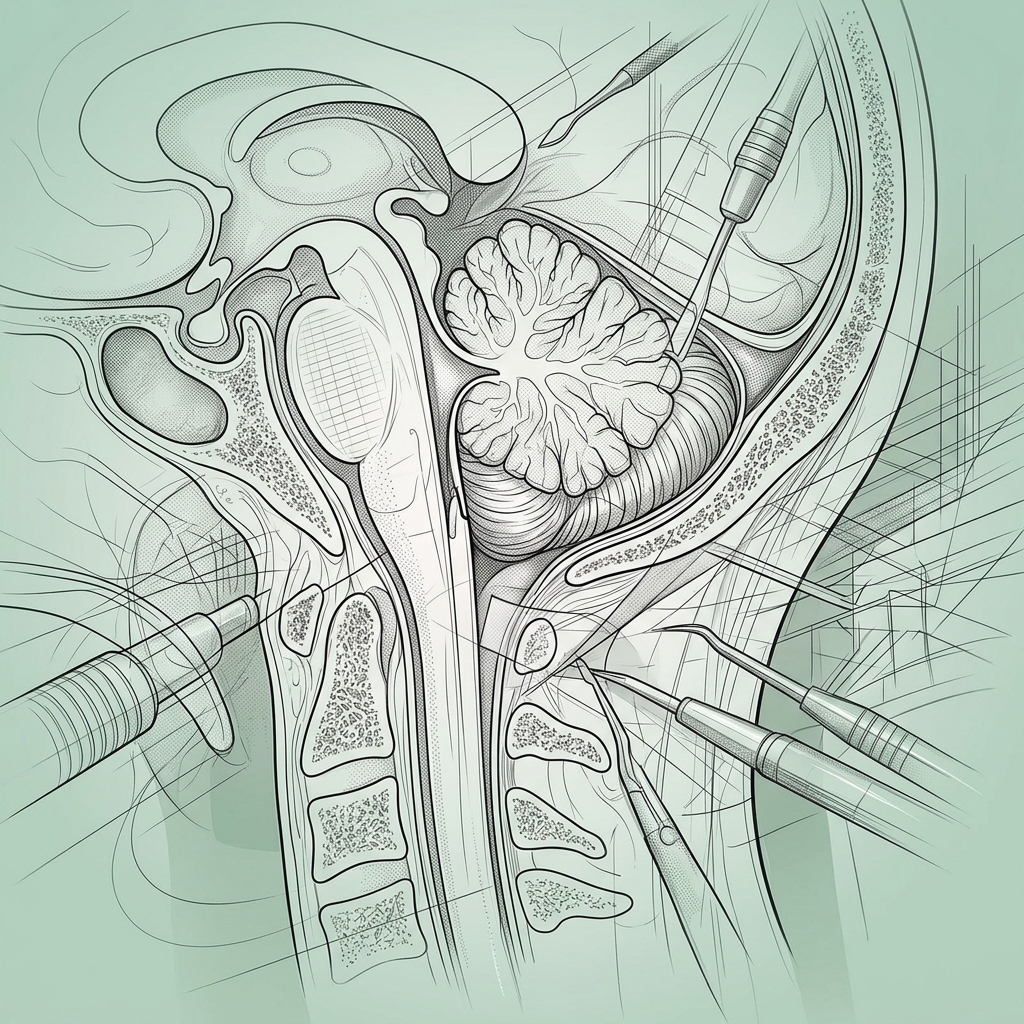 Advanced surgical technology and precision instrumentation.
 Expected outcomes
Posterior fossa decompression provides symptom improvement in approximately 80% of carefully selected patients. Headaches typically improve significantly. Syringomyelia often stabilises or reduces after successful decompression.
 Rehabilitation pathways and safe movement restoration.
 Frequently asked questions
Is Chiari malformation hereditary?
There may be a genetic component, as Chiari malformation can occasionally run in families. However, most cases occur sporadically without a clear hereditary pattern.