Trigeminal Neuralgia
Trigeminal neuralgia is a chronic pain condition affecting the trigeminal nerve, which carries sensation from the face to the brain. It causes sudden, severe, electric shock-like facial pain, usually on one side, that can be triggered by everyday activities such as eating, talking, or touching the face.

Symptoms
- Sudden, severe, stabbing or electric shock-like pain on one side of the face.
- Pain episodes lasting from a few seconds to two minutes.
- Pain triggered by chewing, speaking, brushing teeth, touching the face, or cold wind.
- Pain-free intervals between attacks, though these may shorten over time.
- Pain typically affecting the cheek, jaw, teeth, gums, or lips (V2 and V3 distributions).
- Pain may be mistaken for dental problems.
 Clinical anatomical model showing affected spinal structures (no text).
 Causes and risk factors
- Compression of the trigeminal nerve root by a blood vessel (artery or vein) near the brainstem.
- Multiple sclerosis causing demyelination of the trigeminal nerve.
- Less commonly, a tumour compressing the trigeminal nerve.
- In some cases, no specific cause is identified.
How diagnosis is made
- Clinical diagnosis based on the characteristic pain pattern and triggers.
- MRI with dedicated trigeminal nerve sequences to identify vascular compression.
- MRI to exclude tumours or multiple sclerosis.
- MRA to visualise the relationship between blood vessels and the nerve.
 Typical diagnostic grey-scale imaging scan (MRI/CT).
 Non-surgical treatment options
- Carbamazepine is the first-line medication and is often highly effective.
- Oxcarbazepine as an alternative if carbamazepine is not tolerated.
- Other medications including pregabalin, gabapentin, or baclofen.
- Gradual dose adjustment to balance pain control and side effects.
When surgery may be considered
Surgery is considered when medications become ineffective, cause intolerable side effects, or when the patient prefers a more definitive treatment. Microvascular decompression (MVD) is the gold-standard surgical procedure, involving moving the compressing blood vessel away from the nerve.
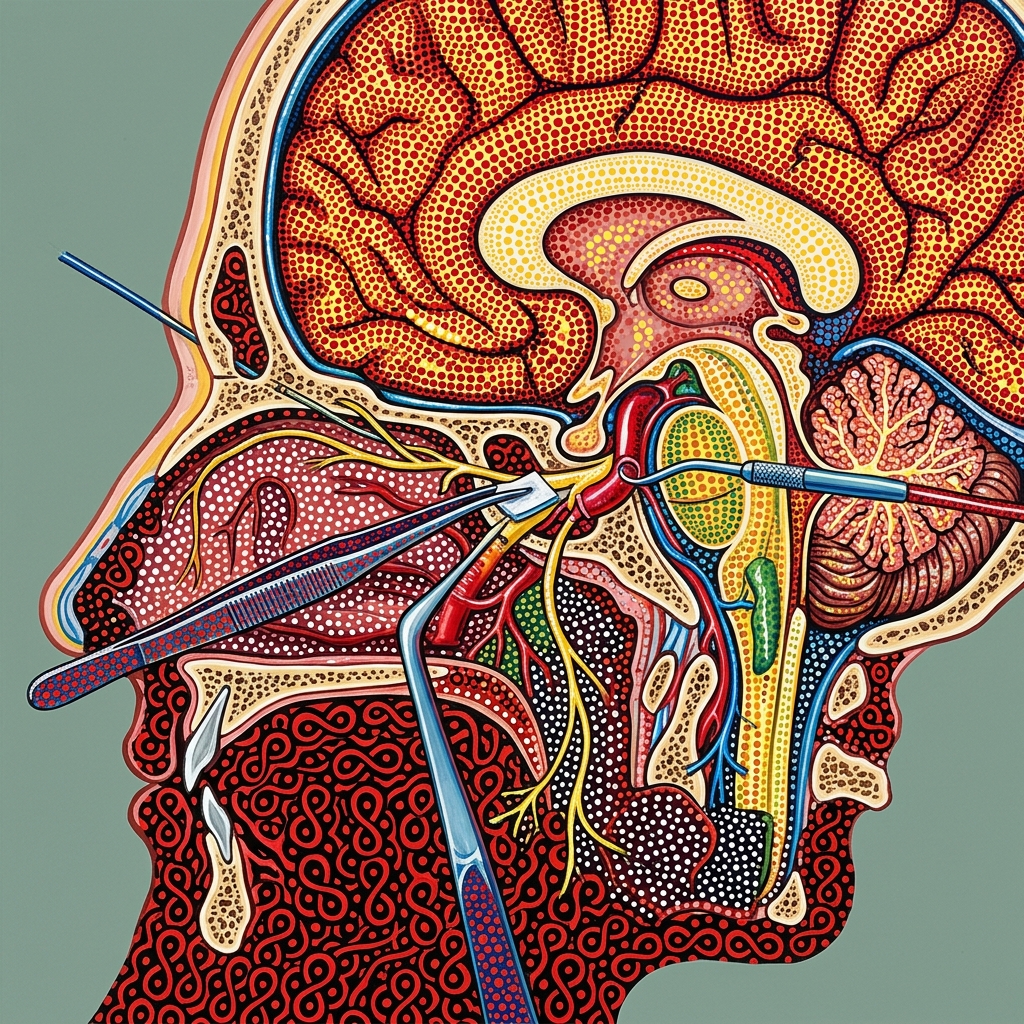 Advanced surgical technology and precision instrumentation.
 Expected outcomes
Microvascular decompression achieves complete or near-complete pain relief in approximately 80 to 90% of patients. It is the most durable treatment option. Alternative procedures include percutaneous rhizotomy and stereotactic radiosurgery for patients who are not suitable for MVD.
 Rehabilitation pathways and safe movement restoration.
 Frequently asked questions
Is trigeminal neuralgia the same as a toothache?
Trigeminal neuralgia can be mistaken for dental pain because the trigeminal nerve supplies sensation to the teeth and gums. If dental treatment has not resolved your facial pain, a neurological assessment for trigeminal neuralgia may be appropriate.
Can trigeminal neuralgia go away on its own?
Trigeminal neuralgia may have periods of remission, but it typically recurs and can worsen over time. Treatment is usually needed to manage the pain effectively.